Skip to the concepts
POINTCAST ↗El Segundo, California / studio concept 01

EL SEGUNDO BUILDWORKS

Small things.
A sense
of place.

Pins, stickers, magnets, ornaments and the little elements that bring them together. Art for a pocket, a wall, a gift, a day.

Explore the six studies

An independent studio idea, with the making questions left open.

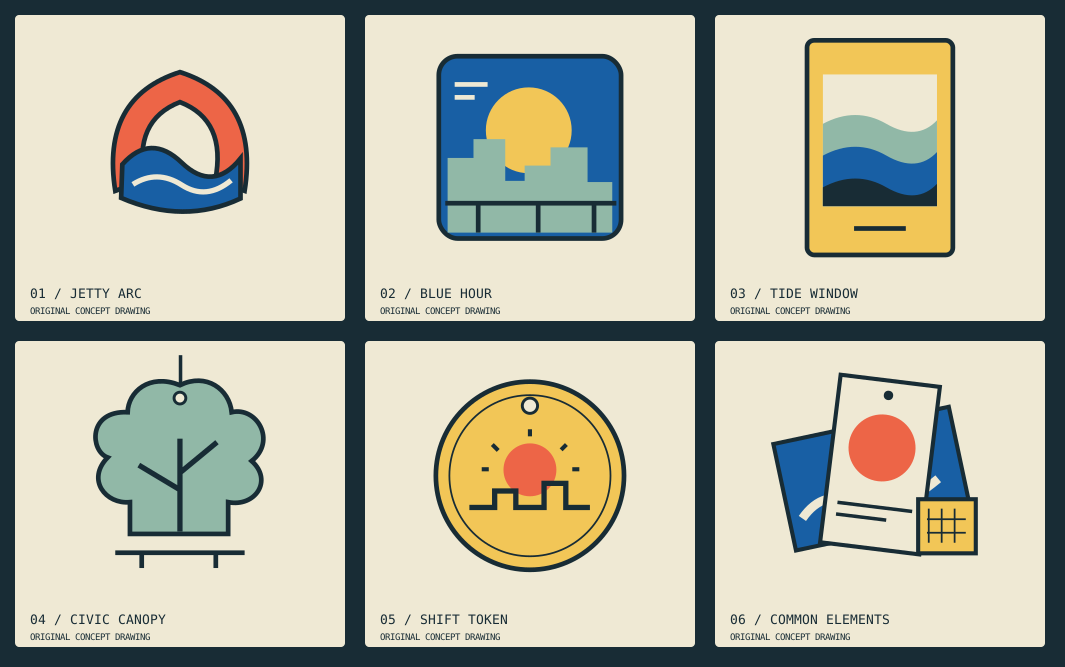
Six original flat design studies: a coral wave pin, cobalt coastal sticker, yellow tide magnet, green canopy ornament, sun medallion and graphic paper tags
THE FIRST SIX / DRAWN FOR EL SEGUNDOCONCEPTS, NOT INVENTORY

01 / THE FIRST COLLECTION

Coast. City.
Working day.

Wave sets, the marine layer, a street canopy, the geometry of work. Six visual prototypes turn local observations into a shared graphic language. Materials and sizes are proposals.

BW / 01ORIGINAL CONCEPT
Jetty Arc, an original flat pin / enamel + metal concept drawing

Pin / enamel + metal

Jetty Arc

A cobalt horizon held inside an open arc. A pocket-sized memory of wave sets and the meeting of coast and infrastructure.

Proposed material + proof questions

Scale. Proposed 28 × 24 mm; thickness and clutch to quote

Material. Proposed plated base metal with two enamel colors. Base alloy and finish declarations required.

First question. Can two large color fields stay legible at pin scale, without fragile bridges?

Sample check. Check scaled artwork, minimum metal bridges, enamel fill, plating consistency, front/back edges, pin post placement and clutch retention. Agree tolerances with the maker before sample approval.

BW / 02ORIGINAL CONCEPT
Blue Hour, an original flat sticker / print + paper or film concept drawing

Sticker / print + paper or film

Blue Hour

An original coastal grid: sunset circle, hangar-like blocks and a low blue horizon. El Segundo’s working landscape translated into shapes, with no copied building logo or civic seal.

Proposed material + proof questions

Scale. Proposed 75 × 75 mm rounded square

Material. Paper label for indoor packaging, or durable film for a surface-use version. These have different end-of-life paths.

First question. Does the composition read at arm’s length and after a small edge scuff?

Sample check. Check CMYK proof, bleed and cut line, adhesive/substrate suitability, corner lift, rub resistance and removal residue on the intended surface. Outdoor life is unverified until tested.

BW / 03ORIGINAL CONCEPT
Tide Window, an original flat magnet / flexible sheet concept drawing

Magnet / flexible sheet

Tide Window

Three tide bands cross a yellow window. A quiet graphic reminder that the same stretch of water keeps changing.

Proposed material + proof questions

Scale. Proposed 65 × 85 mm with rounded corners

Material. Proposed printed flexible magnetic sheet. No detachable high-powered magnet is proposed; product-specific safety review still required.

First question. Will the graphic and backing survive handling on the chosen steel surface?

Sample check. Check dimensions, flatness, backing adhesion, edge damage, print wear and holding performance on intended substrates. Keep magnets from children and inspect any separation; sheet format is not a safety certification.

BW / 04ORIGINAL CONCEPT
Civic Canopy, an original flat ornament / wood + cord concept drawing

Ornament / wood + cord

Civic Canopy

A sculptural tree crown over a simple sidewalk. A civic shape for a room, a seasonal display or a gift wrap, drawn from the feeling of Main Street shade.

Proposed material + proof questions

Scale. Proposed 80 × 85 mm; 3 mm wood as quote starting point

Material. Proposed responsibly sourced plywood with water-based print if validated. Cord, ink, adhesive and finish need documented specifications.

First question. Can the hanging hole and grain orientation resist repeated handling?

Sample check. Inspect splinters, cut edges, hole strength, cord attachment, print alignment and coating transfer. Agree wood variation range. Keep cords and small parts away from young children; not a toy.

BW / 05ORIGINAL CONCEPT
Shift Token, an original flat small metal object / medallion concept drawing

Small metal object / medallion

Shift Token

A sun and a stepped horizon mark the end of a workday. An abstract keepsake for a key ring or desk, with no denomination, currency claim or industrial certification.

Proposed material + proof questions

Scale. Proposed 35 mm diameter with an integral hole

Material. Proposed stamped aluminum or brass. Alloy, plating, surface finish, skin contact and attachment suitability to verify.

First question. Does the relief stay readable while the edges remain comfortable?

Sample check. Check burrs, edges, hole geometry, surface staining, coating adhesion and key-ring wear. Request approved finishing and material declarations; final process and tooling remain quote-dependent.

BW / 06ORIGINAL CONCEPT
Common Elements, an original flat elements / paper components concept drawing

Elements / paper components

Common Elements

A small alphabet of waves, grids and warm circles: hang tags, backing cards, bands and color chips that let the object family speak in one voice.

Proposed material + proof questions

Scale. Proposed 90 × 55 mm tags and folded bands; dieline to confirm

Material. Proposed uncoated paper with one or two inks. Elements means materials and components, not chemical fabrication.

First question. Can one paper size serve a pin, an ornament and a short care note?

Sample check. Check trim, fold/crease, stock grain, ink rub, barcode readability if used and pack count. Test attachment and shipping fit. Confirm paper sourcing and local disposal instructions before claims.

Original vector illustrations, not product photographs, CAD or production-ready artwork. Read the provenance record ↗

02 / FROM IDEA TO A SMALL RUN

Earn the
next batch.

A shared production framework for small goods, paper components and a future puzzle line. A supplier’s public capability is a lead to investigate; a signed-off sample is a different kind of evidence.

01 / DEFINE

One job.
One audience.

Write intended use, scale, budget ceiling and rights log. Make a full-size paper model; choose whether this needs to exist as a physical object.

02 / QUOTE + PROOF

One controlled
revision.

Ask for comparable quantities and itemized costs. Freeze an artwork revision, inspect front/back proofs and approve a physical sample before authorizing a run.

03 / PILOT + INSPECT

One small
learning batch.

Use an affordable quantity. Record the supplier lot, inspect every piece in the first pilot, track defects, test packaging and retain an approved reference sample.

04 / REVIEW

One honest
decision.

Compare cost, demand evidence, returns and material waste with the brief. Reorder, revise, repair or stop. A bigger batch needs a reason beyond a cheaper unit price.

No fabrication recipe here. This notebook covers design, sourcing and inspection. Metal finishing, machining, chemical processes and powered cutting belong with qualified makers operating appropriate facilities.

03 / PROCESS IS PART OF THE DESIGN

Same motif.
Different object.

Printing, enamel and embroidery translate an image in different ways. These comparisons guide a quote conversation; a supplier must confirm its tolerances and process for the actual design.

Raised metal lines; color sits lower

Soft enamel

Good starting point
Simple bold pin or medallion shapes
Design tradeoff
A die/mold and separated color cells make tooling relevant. Recesses change the tactile finish; fine lines and small bridges need maker review.
Proof to request
Vector metal boundaries, color references, plating, back/post placement and physical sample
Material afterlife
Mixed metal, enamel and attachment; plan long use, not a blanket curbside recycling claim.

Smoother polished surface

Hard enamel

Good starting point
A flat, durable-feeling pin face
Design tradeoff
Filling and polishing add process steps. Color/plating limits and unit cost are supplier-specific; do not assume every soft-enamel design transfers unchanged.
Proof to request
Color cells, polishing detail, plating compatibility and approved sample
Material afterlife
A small composite keepsake; preserve material evidence and repair/attachment options.

Flat printed detail or shallow relief

Printed metal / relief

Good starting point
Gradients, fine image detail or a spare token
Design tradeoff
Print can carry detail without many enamel cells. Protective coating, exposed edges, relief tooling and wear differ; stamping and printing are separate quote paths.
Proof to request
Substrate/alloy, print or relief artwork, protective finish and rub/wear test
Material afterlife
Coatings and mixed attachments complicate recovery. Identify materials rather than promising recyclability.

Thin, adhesive, full-color

Printed sticker

Good starting point
Low-risk art sampling and packaging graphics
Design tradeoff
Paper is useful indoors; film may tolerate more exposure but adhesive and liner create waste. Confirm exact substrate and intended surface.
Proof to request
Scaled CMYK artwork, supplier bleed/cut line and adhesive trial
Material afterlife
Ask about liner and adhesive waste. A paper face alone does not make the entire sticker recyclable.

Flat, removable on suitable steel

Flexible magnet print

Good starting point
A graphic for a fridge or steel cabinet
Design tradeoff
Requires backing/print bonding and a defined holding task. Avoid detached high-powered components; no magnet format is automatically child-safe.
Proof to request
Thickness, substrate compatibility, edge/peel checks and safety classification
Material afterlife
Usually a composite. Durable use and restrained packaging are safer claims than universal recycling.

Grain and warm cut edges

Printed wood ornament

Good starting point
Seasonal keepsakes with a hanging point
Design tradeoff
Grain, edge color and print can vary. Hole strength, splinters, cord and coatings need sample inspection; quote assembled and unassembled options.
Proof to request
Scaled outline, hole clearance, grain/print tolerance and cord attachment
Material afterlife
Coatings, glue and cord matter. Verify source claims and avoid assuming compostability.

Light, matte, foldable

Paper + card

Good starting point
Backing cards, bands, tags and element kits
Design tradeoff
Low tooling for standard sizes; custom dies and finishing add cost. Match stock, crease and ink to handling and shipping needs.
Proof to request
Dieline, trim/bleed, grain direction, fold dummy and printed sample
Material afterlife
Simple unlaminated designs can reduce material complexity; local collection rules and inks still matter.

Thread texture with stitched boundaries

Embroidered patch

Good starting point
A textile translation of a bold motif
Design tradeoff
Stitch density, thread changes and backing affect quote and stiffness. Tiny type and gradients become thread decisions; requires a redesigned sample, not just a pin file.
Proof to request
Digitized stitch proof, border, backing, thread colors and sew/adhesion trial
Material afterlife
Mixed fibers, backing and adhesive. Specify composition and attachment before making care claims.

04 / TAKE A BETTER QUESTION TO A MAKER

Your idea.
A useful brief.

Choose a visual study and a process. Add your intended use and the question you want to answer. Download a plain-text discussion brief, including your current pilot assumptions.

Interactive tools require JavaScript. The concept details and blank workbook below remain readable.

Plausible process to quote. The maker must confirm feasibility.

Nothing is submitted. Your draft is not a supplier order.

Download the blank pilot workbook ↓

Jetty Arc, original flat concept illustration

BRIEF PREVIEW

Original design.
Open questions.

EL SEGUNDO BUILDWORKS / MAKER DISCUSSION BRIEF
Original concept; not an order, approved specification or tested product.

Concept: Jetty Arc / Pin / enamel + metal
Idea: A cobalt horizon held inside an open arc. A pocket-sized memory of wave sets and the meeting of coast and infrastructure.
Proposed scale: Proposed 28 × 24 mm; thickness and clutch to quote
Process to discuss: Soft enamel
Process fit: Plausible process to quote; maker must confirm feasibility.
Finish tradeoff: A die/mold and separated color cells make tooling relevant. Recesses change the tactile finish; fine lines and small bridges need maker review.
Quantity to quote: Quote 25 / 50 / 100; confirm supplier minimum
Audience / intended use: Adult decorative use; age classification still needs review.
Design question: Can two large color fields stay legible at pin scale, without fragile bridges?

QUOTE / PROOF REQUEST
Confirm substrate, thickness, finish, dimensional tolerances, color method, attachments and packaging.
Separate tooling, samples, unit price, freight, import charges, tax, proof revisions and defect/remake terms.
Ask for MOQ per artwork/colorway, approved sample lead time, production start trigger and shipping window.
Supply original vector outlines and a scaled PDF; request supplier-specific bleed/cut and minimum line guidance.
Require a marked front/back proof. Approve artwork revision and physical sample separately.

RELEASE GATES
Rights log for artwork, fonts, photos and marks; no copied civic seal, commercial character or implied endorsement.
Determine intended age/use before making a label. Small parts, pin points and magnets require product-specific safety review.
Confirm materials/finish declarations and applicable testing with supplier or qualified lab; an adult label alone does not exempt a children’s product.
Write a dated sample/QC checklist; retain approved sample, lot identifier and defect photographs.
Test packaging, handling, attachment durability and shipping with a small pilot before a larger run.
Avoid unverifiable recycled, recyclable, non-toxic or child-safe claims.

ACCEPTANCE PLAN
Check scaled artwork, minimum metal bridges, enamel fill, plating consistency, front/back edges, pin post placement and clutch retention. Agree tolerances with the maker before sample approval.

BATCH RECORD
Artwork revision: ___  Approved proof: ___  Sample: ___  Supplier lot: ___
Material/finish evidence: ___  Test report scope: ___  Rejected units: ___
Pack-out count: ___  Returns/remake policy: ___  Release decision: ___

ILLUSTRATIVE PILOT INPUTS / NOT A QUOTE OR SALES FORECAST
quantity: 100
unitCost: 2.5
packaging: 0.6
freight: 45
tooling: 120
rejectPercent: 5
price: 12
shipping: 3.5
feePercent: 3
feeFixed: 0.3
returnReserve: 0.4
sellThrough: 70
wholesalePrice: 6
Saleable units: 95; assumed sold: 66; cash committed USD: 475.00
Model excludes tax, duties, insurance, labor, overhead and multi-item order effects. Replace assumptions with quotes.

05 / PRICE THE LEARNING, TOO

A small run.
Real questions.

An illustrative USD model for one product, one item per direct order. Every value is editable. These are assumptions, not actual sales, supplier quotes or a demand forecast.

Model a first batch

What this batch asks of you.

UPFRONT BATCH CASH$475.0095 saleable / 5 rejected
LANDED / SALEABLE UNIT$3.7468.9% gross margin
DIRECT CONTRIBUTION / UNIT$3.7030.9% after selling costs
BATCH CASH RESULT$16.0466 assumed sold / 29 unsold
  • 33 units to recover tooling
  • 64 sales to recover all batch cash
  • 37.7% wholesale gross margin

Gross margin compares sale price with landed cost. Contribution also subtracts seller-paid shipping, fees and the return reserve. Neither is net business profit.

Batch cash result charges the entire batch upfront, including unsold inventory, plus tooling/samples. Sell-through rounds down to whole units; rejects reduce saleable stock.

Wholesale shows gross margin only. Add freight, payment terms, discounts, returns and channel costs before accepting an order.

Read the math and what is missing

Saleable units = floor(ordered × (1 − reject %)). Landed cost = (ordered × (unit cost + packaging) + inbound freight) ÷ saleable units. Packaging is assumed purchased for every ordered unit.

Net receipt per sale = price − percentage fee − fixed fee − seller-paid outbound shipping − return reserve. Contribution = net receipt − landed cost. Tooling break-even = ceil(tooling ÷ positive contribution). Cash recovery units = ceil(all batch cash ÷ positive net receipt); they can exceed available stock.

Batch cash result = floor(saleable × sell-through %) × net receipt − (all inventory cash + tooling). Unsold stock is still an asset with uncertain recoverable value; this conservative cash view expenses its full cost immediately.

This model excludes taxes, import duties, labor, overhead, insurance, storage, financing, discounts and multi-item order effects. The return reserve is an expected expense allowance, not a return-rate prediction. Shipping subsidies must be included honestly. Negative contributions have no tooling break-even.

Start with 30%, 70% and 100% sell-through as arbitrary sensitivity scenarios; do not treat them as demand evidence. Replace every assumption with actual quotes and observed pilot data before a production decision.

06 / THREE WAYS TO START SMALL

A business plan
with gates.

Keep the product, operating cost and cash cycle visible. A storefront, a local retailer and a commission each create different commitments.

Direct pilot

One design, one process, a modest quantity. Test interest with interviews or clearly labeled mockups before committing cash.

  • Budget tooling, samples, inventory, rejected pieces and pack-out labor.
  • Pay deposits/balance on agreed terms; stock and freight cash leave before sales arrive.
  • Record conversion, damage, return reasons and support time; these are future observations.
  • Set an honest dispatch window, return/refund terms and lost/damaged parcel policy before selling.

Wholesale capsule

A few coordinated objects for an independent retailer. Price for the actual channel rather than assuming retail margin survives a discount.

  • Quote case packs, minimums, samples, packaging and retailer requirements.
  • Model payment delay, retailer margin, returns, markdown support and outbound cartons.
  • A purchase order has obligations; consignment leaves stock risk with the studio.
  • Reorder only from sell-through evidence and verified capacity/lead time.

Custom commission

A visual motif for a venue, event or community group, subject to rights permission and a written project scope.

  • Separate design fee, prototype/tooling, unit manufacture, freight and rush charges.
  • Define licensed artwork use, revisions, approvals, cancellation and defect/remake terms.
  • Schedule around sample approval and production windows; reserve time for a failed proof.
  • No venue, city, school or brand collaboration is claimed by these concept studies.

07 / CARE BELONGS IN THE BRIEF

Proof it.
Then prove it.

A digital proof is an artwork check. A physical sample checks materials and construction. Neither alone certifies product safety, durability or a complete production run.

The first-pilot quality record

  1. Freeze the specification. Record artwork revision, dimensions, color references, substrate, thickness, finish, attachments and packing method. Use supplier-specific minimum line and bleed guidance.
  2. Approve the sample separately. Compare the physical sample with the marked proof in controlled light. Agree measurable tolerances and acceptable color/material variation in writing.
  3. Inspect the first small lot. Proposed pilot policy: inspect every unit, photograph defects and count pack-out. Check print/finish, edges, attachments and function against the retained sample.
  4. Test the real journey. Handling, pin/clutch retention, backing adhesion, cord/holes, abrasion and a packaged shipping trial need product-specific procedures. Do not invent a load or durability rating.
  5. Record a release decision. Retain lot identification and evidence. For later larger batches, agree sampling and critical/major/minor defect rules with a qualified quality professional; no AQL certification is claimed here.

Rights, age, materials and waste

  • Keep a rights ledger for drawings, photographs, fonts and marks. A city seal, team emblem or commercial character needs permission or a valid applicable license. Original art does not establish trademark clearance.
  • Determine intended age and use before selecting labels. Small parts rules, sharp pin points, magnet ingestion hazards and children’s-product testing/traceability can apply. An “adult collectible” statement is not a substitute for classification.
  • Ask for exact alloy, inks, coatings, adhesive and backing composition plus relevant test reports. Report scope must match the material, age category and product; “non-toxic” or “child-safe” is not established by a supplier slogan.
  • Start with a simple backing card or paper band where it protects the piece. Compare damaged-goods waste with packaging saved; avoid unnecessary laminate and mixed-material decoration.
  • Verify recycled content, sourcing and disposal claims for the actual item and local collection system. Keep care instructions and batch identifiers legible. Supplier certification claims are leads to verify.

US rules and source links below provide starting points. Product-specific compliance and destination-market requirements need qualified review before sale.

08 / OPEN SOURCE NOTEBOOK · CHECKED 2026-10-03

Read the
fine print.

Primary sources and public supplier examples. Minimums, prices and lead times can change. These are research leads, with no affiliate links, quote acceptance or endorsement.

  1. supplier / 2026-10-03

    Enamel pin reference prices ↗

    Public table: 100 one-inch soft-enamel pins at US$3.00 each ($300 reference subtotal); hard enamel US$3.09 each ($309). Advertises no minimum and about 20 days production after artwork approval.

    Limits. Reference pricing only. Calendar vs business days is unspecified. Artwork, plating, backing, packaging and shipping change the quote; tooling, taxes and freight require confirmation.

  2. process / supplier / 2026-10-03

    Enamel and printed pin options ↗

    GS-JJ describes recessed soft enamel, polished hard enamel and printed detail/gradients. States minimum one piece with a fixed mold fee. Published examples: 2–7 business days enamel, 4–6 UV print, plus 3–5 business days shipping.

    Limits. Promotional starting prices are not comparable selected configurations. Exact artwork, mold fee, finish and sample approval may change cost and timing; these are supplier claims, not commitments.

  3. supplier / 2026-10-03

    Die-cut sticker pilot ↗

    Published minimum 10 stickers, online proofs/revisions and four-day turnaround. Die cutting cuts both sticker and backing to the outline; kiss cutting retains a larger backing.

    Limits. Price is quote/calculator required for actual size and quantity. Vinyl, matte finish and durability are supplier claims; test intended surface and confirm whether turnaround includes transit.

  4. supplier / 2026-10-03

    Flexible printed magnets ↗

    Described as ferrite/rubber/plastic sheet with a white vinyl face, about 0.38 mm / 15 mil. The supplier says there is no UV laminate and extended outdoor exposure may fade print.

    Limits. Selected price, MOQ and delivery need confirmation. Supplier pull-strength claims do not establish product safety or applicable regulatory classification.

  5. supplier / 2026-10-03

    Wood ornament production example ↗

    Zap Creatives lists 4 mm maple veneer ornaments up to 75 mm / three inches, with printed finishes and thread options. Publishes 7–9 working days after proof approval; assembly can add 1–2 days.

    Limits. Shipping is separate; exact price/availability require confirmation. Buildworks proposes different dimensions, so this listing is a process example rather than a quote for Civic Canopy.

  6. supplier / 2026-10-03

    Wood charms and single samples ↗

    Maple, cherry or walnut veneer wood charms, with single-unit samples and a published 7–9 working-day production window after proof approval. Natural grain varies.

    Limits. Supplier-specific 4 mm veneer and tolerances need checking against artwork. Assembly may add 1–2 days; shipping, pricing and order acceptance remain unconfirmed.

  7. supplier / 2026-10-03

    Standard paper-card price benchmark ↗

    MOO Original cards: 50 for US$23 ($0.46 each) or 100 for $45 ($0.45 each), on 16 pt / 130 lb stock. Standard trim 3.5 × 2 inches with matte/gloss options.

    Limits. A card-printing benchmark, not custom backing-card manufacture. Holes, assembly, shipping and tax are separate; delivery depends on the calculator and chosen service.

  8. process / supplier / 2026-10-03

    Embroidery coverage and backing ↗

    GS-JJ explains how embroidery coverage changes visible fabric, texture, weight and cost. Bold shapes translate better than tiny lettering/fine lines. Lists a single-patch minimum, proof revisions and sew-on, adhesive and other backing options.

    Limits. Selected price and delivery require a configuration-specific quote. Starting prices are not comparable sizes/coverage. Backing and garment compatibility need physical trials; supplier claims do not establish performance.

  9. safety / US / 2026-10-03

    Small parts and intended audience ↗

    CPSC explains prohibited small parts in products intended for children under three, and warning requirements for certain toys/games for ages three through six. Design, marketing and recognized use matter to age classification.

    Limits. A stated adult or 14+ label alone does not settle classification. Review the exact product, packaging, advertising and intended destination market before sale.

  10. safety / US / 2026-10-03

    Magnet requirements ↗

    CPSC describes scope and testing for magnet products, including loose or separable magnets. A decorative product name does not establish exemption. Magnet ingestion can cause serious injury.

    Limits. Confirm scope under current 16 CFR 1262 or the applicable toy standard with a qualified reviewer. This page and our flexible-sheet concept do not certify compliance.

  11. safety / US / 2026-10-03

    Children’s product tracking labels ↗

    CPSC explains permanent legible tracking marks on products and packaging to the extent practicable: responsible manufacturer/private labeler, production location/date and batch/run details.

    Limits. Apply the rules to the actual children’s product and any relevant exception. Keep batch records even when marking space is limited.

  12. materials / US / 2026-10-03

    Lead limits and material evidence ↗

    CPSC guidance describes the total-lead limit for accessible children’s-product components. Substrate, coating, ink and fastener need applicable evidence; an SDS alone does not establish compliance.

    Limits. This guidance does not certify a supplier or our concepts. Coatings, electroplating and paint can have different testing rules; obtain product-specific reports and certificates as applicable.

  13. materials / US / 2026-10-03

    Paint and surface-coating guidance ↗

    CPSC explains lead-in-paint rules and distinctions among paints, printing and electroplating. Ask the maker to identify the coating and its applicable test scope.

    Limits. Treatment differs by product/material. Do not infer safety or an exemption from the word enamel, water-based, plated or printed.

  14. rights / 2026-10-03

    Copyright and original expression ↗

    The US Copyright Office distinguishes original fixed expression from ideas. Keep written merchandising/reproduction permission for commissioned and third-party art, photos and fonts.

    Limits. An original motif does not automatically clear all reference material or establish exclusive rights. No third-party artwork is licensed by this notebook.

  15. rights / 2026-10-03

    Trademark basics ↗

    USPTO explains trademarks as source identifiers. Check studio/collection names and conflicting marks before a commercial launch, and document any authorized brand use.

    Limits. These original designs make no endorsement claim. This source does not establish that El Segundo Buildworks or its concept names have been cleared.

  16. packaging / claims / 2026-10-03

    Environmental claims and packaging ↗

    FTC guidance advises substantiating and qualifying environmental claims, including recyclability, recycled content and non-toxic claims. Specify whether a claim covers the product, its packaging or only a component.

    Limits. The posted summary describes the 2012 Green Guides. Paper/wood content alone does not justify broad eco-friendly, recyclable or compostable promises; actual materials and local access matter.

Prices are in USD unless stated. Use the exact source configuration; do not scale a price to a different size, finish or quantity. Compare total landed cost, sample approvals, defect terms and delivery window. No supplier has been contacted.

09 / BUSINESS × DESIGN / AN OPEN CASE

Make the object.
Keep the lesson.

A proposed Buildworks case for University of El Segundo business/design study and IndustryNext. Anyone can use these exercises; no class enrollment, student project, institutional agreement or partner engagement is implied.

DESIGN EXERCISE / 45 MIN

Translate one motif.

Draw one local observation in two colors. Compare enamel, print and thread at actual size. Deliver a rights log, one full-scale paper model and a list of process compromises.

BUSINESS EXERCISE / 60 MIN

Stress the batch.

Use the calculator for low, middle and high sell-through. Vary shipping and rejects. Deliver a cash timeline, a quote comparison and a maximum amount you can afford to lose learning.

OPERATIONS EXERCISE / 45 MIN

Write the stop rule.

Define sample approvals and three defect categories. Map packaging and returns. Deliver a batch record and a decision rule for repeat, revise or stop; leave untested claims blank.