A major stadium sewn into campus instead of marooned beyond it.
RECEIPT ↗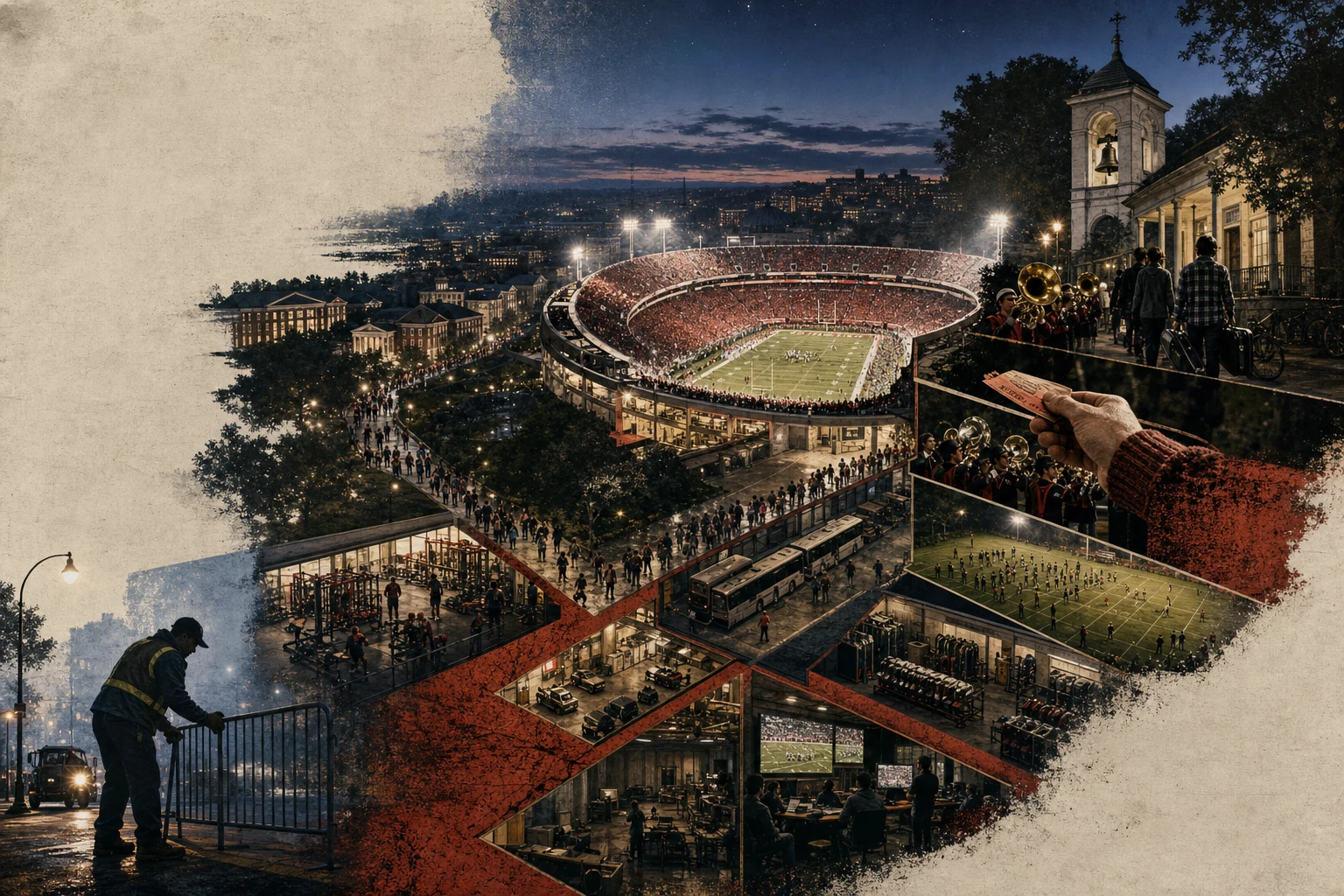
FIELD REPORT · ATHENS, GEORGIA · 2026-08-08
GEORGIA,
GROUND
ZERO.
Georgia may be the most complete operating system in college football. Athens is the reason it still feels like more than one.
Enter before sunrise ↓THE MACHINE AND THE BELL · ORIGINAL POINTCAST EDITORIAL ART · NOT DOCUMENTARY PHOTOGRAPHY
00 / BEFORE THE RED ARRIVES
Ground zero
starts in the dark.
Nearly two hours before sunrise, before the red dresses and black polos, before the first television hit, UGA Police commanders install hydraulic traffic barricades around Sanford Stadium. Two miles away, bus drivers begin their first runs. The command room will eventually watch more than fifty screens. Custodians, grounds crews, dining staff, medical teams, officers, drivers, and outside agencies will turn a normal college town into a one-day city for more than 93,000 people. That is UGA’s own account.
It is tempting to begin Georgia football with Kirby Smart, a blue-chip depth chart, or the hedges. The more revealing opening is a worker in a reflective vest setting a barrier in the dark. The spectacle depends on a system. The system depends on people the broadcast rarely names.
Georgia is college football’s ground zero because almost every force reorganizing the sport is unusually concentrated here: a state thick with players, an institution with immense recurring capital, a coach who has made development reproducible, an NFL pipeline recruits can see, a national-title standard, a city whose scale lets the university and the town occupy the same Saturday, and a fan base large enough to make the whole thing feel civic.
It is also ground zero for the harder question. When college football becomes this capable—when rosters, revenue sharing, acquisition, facilities, security, content, hospitality, and expectation all become professional—what keeps it from becoming only a professional operation wearing a university’s old clothes?
An EADA reporting category—not a claim of football profit.
RECEIPT ↗Georgia Athletics’ count after the 2026 draft.
RECEIPT ↗Seven games if demand and the priority system permit a full package.
RECEIPT ↗One official’s workday in UGA’s account of the invisible operation.
RECEIPT ↗01 / HOW THE MACHINE WORKS
Five inputs.
No alibi.
The word “machine” can flatten the achievement into cash and recruiting. Georgia’s real advantage is that five systems reinforce one another. Remove any one and the room becomes merely expensive.
01THE RADIUS
A state that keeps making football players.
Georgia is not the largest state in the sport. It is one of the densest. NFL data counted 143 players from Georgia high schools on 2025 kickoff rosters and 22 Georgia high-school alumni selected in the 2025 draft. The home territory is a renewable competitive advantage—but only if relationships remain stronger than extraction.
02THE REPETITION
Hard Tuesday is the product.
Kirby Smart describes a developmental factory in plain language: grow the bottom of the roster toward the top, surround positions with many trained eyes, and make practice demanding enough that the game feels recognizable. Georgia’s fewest returning starters of the Smart era make 2026 a useful audit of that claim.
03THE PEOPLE
Continuity is an information advantage.
A stable staff does more than preserve scheme. It keeps thousands of observations, corrections, trust deposits, and recruiting relationships inside the building. Smart said staff retention gives him more time to coach motivation and relationships. The machine’s quietest advantage may be memory.
04THE CAPITAL
Money buys fewer excuses, not guaranteed Saturdays.
Georgia Athletics reported $233.5 million in total revenue and $226.7 million in total expenses for FY2025; football’s revenue category was $149.3 million. Capital makes staff depth, facilities, travel, nutrition, recruiting, and player support ordinary. It also turns every unconverted advantage into a public question.
University of Georgia Athletic Association ↗ · University of Georgia Athletic Association ↗
05THE PROOF
The next level recognizes the work.
Eight Bulldogs were drafted in 2026, bringing Georgia Athletics’ Smart-era total to 82 NFL selections in ten drafts. Championships explain the ceiling. Draft development explains why the room replenishes: recruits can see the path leaving Athens as clearly as the one entering it.
02 / THE 2026 AUDIT
Can the system
replace its own memory?
Georgia enters 2026 as the winner of consecutive SEC championships and the loser of a 39–34 CFP quarterfinal to Ole Miss. That is the Georgia condition now: a 12–2 season can be both proof of the standard and a live source of irritation.
The useful complication is experience. In March, Smart called this the fewest returning starters Georgia has had in his tenure. In August, he described a healthy camp group of roughly 125 to 127 players while the operating roster moves toward the new post-settlement limit. The mandate remains old-fashioned—run the ball, stop the run—while the desired gains are modern and measurable: explosive plays, havoc, turnovers.
This is why 2026 matters beyond Georgia. If the Bulldogs are excellent again, the season will validate something more durable than one recruiting class. It will suggest that the institution has learned how to teach its own standard. If the room wobbles, the problem will not be a missing input. It will be the human difficulty of turning a fresh group into shared memory.
03
THE STUDENT
IS NOT SET DRESSING
The cheapest seat
carries the most meaning.
A Georgia student is simultaneously the most essential participant in the Saturday story and one of its most tightly administered customers.
The 2026 full home package is a remarkable $80 for seven games. That is real access. It is also conditional: if demand exceeds supply, students can be assigned a three-game red package or four-game black package by a priority lottery. One unused ticket produces a strike; two strikes remove postseason eligibility. Tickets cannot transfer directly between students. Away prices run from $140 for Florida to $265 for Alabama. Entry is digital, seating is general admission except organization blocks, and re-entry is not allowed.
Each rule has an operational logic. Together they reveal the tension. Students generate the sound, continuity, youth, risk, handmade dress, remembered friendships, and future alumni demand that make the television product valuable. Yet the more valuable the product becomes, the more managed their presence can feel.
The non-machine move is not nostalgia for paper tickets. It is a firm design priority: treat student access as part of the competitive and cultural infrastructure, not as inventory left after every other revenue decision. A full student section is not a discount. It is the part of the program that still knows tomorrow’s exam exists.
READ THE 2026 STUDENT TICKET RULES ↗ 04 / WHY ATHENS MATTERS
A football city
with another frequency.
Athens keeps Georgia from feeling like a football industrial park. Sanford is not a remote bowl surrounded by parking geometry; it sits inside a campus, beside a town, near classrooms, bars, porches, churches, shops, studios, and stages. A person can feel the day change on foot.
The city’s music history matters because it proves the place can produce a national signal without a central office ordering it into existence. R.E.M. and the B-52s are the famous names, but the useful inheritance is the method: students, cheap rooms, local collaborators, experiments, and enough friction to make a scene. Football’s scale should not erase that ecology. It should learn from it.
A good Georgia Saturday therefore has two economies. One is optimized: tickets, transit, safety, broadcast windows, donor hospitality, roster operations. The other is porous: the person who walks downtown, the band heard from a side street, the breakfast shift, the house gathering, the student who stays for a local show, the vendor whose best customer returns in February. The first economy makes the event work. The second makes it belong somewhere.
05 / THE MODERN COLLEGE EXPERIENCE
Professional inputs.
University obligations.
The old amateur story was never an honest description of the labor or the money. The post-House era permits direct institutional benefits to athletes, replaces scholarship limits with roster limits at participating schools, and makes the financial operating system more explicit. That is progress. It also removes the last excuse for treating care as accidental.
Compensation and elite development belong in the same sentence as health, education, time, agency, and exit options. “Student-athlete” should not be used to hide labor; “employee” should not be used to shrink a young person into one line of roster value.
Modern convenience is useful until every tradition becomes a funnel. The fan experience needs prices and spaces that allow the state to recognize itself, including people without donor history or a premium credential.
Football can be a front porch, laboratory, employer, gathering ritual, and source of pride. It cannot become the institution’s only convincing public story. The academic bell has to remain audible through the lights.
Georgia high schools feed the sport’s national talent economy. The flagship obligation is larger than winning recruiting battles: respect the local coaches, families, schools, and communities that make the radius productive.
06 / HOW TO KEEP IT NON-MACHINE
The Hedges
Test.
Seven questions for Georgia—and every program copying Georgia—to ask while the system is still capable of hearing the answer.
- 01
CAN THE STUDENT STILL GET IN?
Protect affordable, abundant student access before manufacturing one more premium experience.
- 02
ARE PLAYERS PEOPLE BEFORE THEY ARE INVENTORY?
Direct revenue sharing is overdue. Development should still include education, time, health, voice, and a life after the depth chart.
- 03
DOES ATHENS WIN ON THE OTHER 358 DAYS?
Route visitor energy into local rooms, workers, music, public space, and businesses—not only the controlled stadium economy.
- 04
CAN A PLAYER ARRIVE UNFINISHED?
Keep development visible. A sport made entirely of acquired certainty has no room for discovery.
- 05
CAN ANOTHER SPORT OWN THE CATHEDRAL?
Georgia opens Sanford’s 2026 public calendar with women’s soccer. That is not a footnote; it is a model for a university stadium.
- 06
CAN THE PROGRAM SURVIVE BEING MORTAL?
If one loss turns every relationship into an asset review, the machine has started consuming the institution it was built to serve.
- 07
DOES THE BELL RING FOR SOMETHING ELSE?
UGA’s Chapel Bell marks athletic victories and academic accomplishment. Keep the second half of that sentence loud.
07 / AFTER THE BELL
What Georgia
has to protect.
Georgia does not need to become less serious about football. It needs to remain serious about everything football cannot manufacture.
A machine can schedule the bus. It cannot make the ride a student remembers twenty years later. It can optimize a roster. It cannot decide whether a player felt known while he was on it. It can sell the room. It cannot make the town worth walking into. It can amplify the band. It cannot write the song that arrives from a basement nobody funded. It can count the crowd. It cannot explain why somebody rings the Chapel Bell for an academic win.
That is the useful meaning of ground zero. Georgia is not merely where the modern sport looks most complete. It is where the argument about what the sport is for becomes hardest to avoid. The operation is already excellent. The next championship is maintaining a Saturday large enough for the worker, the player, the student, the fan, the town, the other team, the other sport, and the person who came to Athens for a reason football will never know.
THE MACHINE WORKS.
THE BELL STILL HAS TO RING.
SOURCE ROOM / OPEN RECEIPTS
Reporting before mythology.
Primary and official-data sources lead. PointCast interpretation stays labeled as interpretation.
- 01 PRIMARY · UGA Today Game day’s unsung heroes ↗
Pre-sunrise barricades, transit, safety, custodial work, and the duration of game-day operations.
- 02 PRIMARY · Georgia Athletics Smart, players preview 2026 fall camp ↗
Roster state, camp phases, staff retention, identity, and the 2026 women’s soccer match in Sanford Stadium.
- 03 PRIMARY · Georgia Athletics Smart, players preview 2026 spring practices ↗
Returning experience, player development, practice standards, and staff observation.
- 04 PRIMARY · The Georgia Bulldog Club 2026 student football tickets ↗
Prices, lottery packages, ticket donation, strikes, digital entry, general admission, and away-game prices.
- 05 PRIMARY · Georgia Athletics Dooley Field at Sanford Stadium ↗
Official stadium history and 93,033 capacity.
- 06 OFFICIAL-DATA · University of Georgia Athletic Association 2025 EADA Survey ↗
FY2025 athletics and football revenue and expense reporting categories.
- 07 OFFICIAL-DATA · University of Georgia Athletic Association 2025 NCAA Financial Report ↗
Contributions, recruiting, coaching compensation, and other NCAA reporting categories.
- 08 PRIMARY · Georgia Athletics Georgia closes the 2026 NFL Draft ↗
Eight 2026 selections and Georgia Athletics’ Smart-era draft count.
- 09 PRIMARY · Georgia Athletics Kirby Smart coaching profile ↗
Program record, championships, and development history.
- 10 PRIMARY · Georgia Athletics Georgia’s 2026 football schedule ↗
Official opponents, sites, and the Florida game’s move to Atlanta.
- 11 PRIMARY · Georgia Athletics Ole Miss 39, Georgia 34 · CFP quarterfinal ↗
The 12–2 close to the 2025 season after Georgia won the SEC championship.
- 12 OFFICIAL-DATA · NFL Play Football High schools represented on 2025 NFL kickoff rosters ↗
State-of-high-school count, including 143 players from Georgia high schools.
- 13 OFFICIAL-DATA · NFL High schools represented in the 2025 NFL Draft ↗
State count, including 22 selections from Georgia high schools.
- 14 PRIMARY · University of Georgia UGA history and traditions ↗
The Chapel Bell, Light Up Sanford, band ritual, and other campus traditions.
- 15 PRIMARY · UGA Today In a music town, tomorrow’s leaders take center stage ↗
Athens music history and the continuing student/community music ecosystem.
- 16 PRIMARY · NCAA House settlement roster changes ↗
Roster limits, scholarship changes, and the post-settlement Division I framework.
- 17 PRIMARY · Georgia Athletics 2026 Georgia football roster and staff ↗
Current player and staff listing.